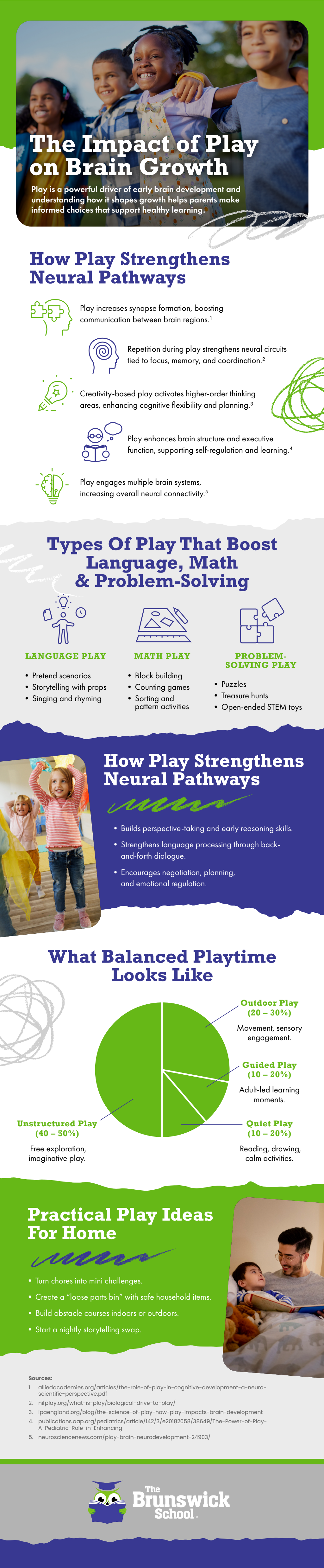
Play is not a break from learning for children. It is one of the most powerful ways learning happens. Long before formal lessons begin, play helps shape how children think, interact, and understand the world. While early academics often receive the spotlight, play quietly builds the cognitive, social, and emotional foundations that support long-term growth. Through curiosity and exploration, children gain confidence, flexibility, and a willingness to engage with new challenges.
From a brain development perspective, play is highly active work. When children play, they experiment, test ideas, and make connections across different areas of the brain. These experiences strengthen skills such as focus, memory, and self-control. Rather than memorizing information in isolation, children learn how ideas relate to one another. Play encourages the brain to remain adaptable, helping young learners respond creatively and effectively as situations change.
Social and emotional skills also develop naturally through play. Interacting with others teaches children how to share space, express needs, and understand different perspectives. Games and imaginative scenarios offer opportunities to practice cooperation, patience, and compromise. When disagreements arise, children learn how to negotiate and regulate emotions in real time. These experiences lay the groundwork for empathy, emotional awareness, and healthy relationships later in life.
Language growth flourishes in playful settings. Storytelling, pretend play, music, and conversation introduce new words and sentence patterns in ways that feel engaging and meaningful. Mathematical thinking and logical reasoning emerge through activities like sorting, building, counting, and recognizing patterns during games. Problem-solving skills develop as children figure out how to complete puzzles, design structures, or navigate imaginary worlds. These playful challenges prepare children for academic learning while keeping their motivation strong.
Caregivers and families play an important role in protecting space for play. Offering time for open-ended exploration, movement, and outdoor activity supports both physical and mental development. Adults can enhance play by asking thoughtful questions, introducing varied materials, and allowing children to direct their own experiences. Even small changes, such as slowing down schedules or reducing screen time, can open the door to richer play opportunities.
When adults prioritize play, they communicate something meaningful to children. Their curiosity is important. Their ideas matter. Learning can be enjoyable and self-directed. By valuing play, caregivers help children develop a lifelong love of learning, along with the confidence and resilience needed to face future challenges with enthusiasm.
For additional insights into the connection between play and brain development, explore the accompanying resource from The Brunswick School, a provider of early childhood classrooms.